If you want to know more about my research, you can find a summary of major themes in my work here, and a list of my publications here. My policy briefs and popular press articles are available via the Scholars Strategy Network (SSN), and The Conversation. See below for recent news.
Li & Fort receive awards at NCA


It is such a joy to see your students excel! Qin Li (PhD., 2024) and Kara Fort (MA, 2023) were both acknowledged for their research awards at the 2025 NCA Political Communication business meeting.
Receiving the Charles H. Woolbert Research Award
I’m deeply honored to have been selected to receive the Charles H. Woolbert Research Award from the National Communication Association. The Woolbert Award is given to scholars whose published research has stood the test of time, having significantly influenced the study and practice of communication over the past decade or more. To be included among the scholars and educators who have received this award is both humbling and inspiring.
The work being recognized reframed the debate around selective exposure to political information. In a media landscape defined by choice, this research introduced to political communication the idea that while people do prefer opinion-reinforcing content, they do not systematically avoid exposure to opposing views. This distinction matters: avoiding challenges to one’s beliefs is far more damaging to democratic discourse than simply seeking reinforcement. The findings of this paper, which were based on a national survey conducted before the 2004 U.S. presidential election, suggest that Americans use online media to deepen their engagement with like-minded perspectives without entirely closing themselves off to alternative viewpoints.
I’m proud that this research continues to contribute to our understanding of political communication and media effects. I look forward to formally accepting the award at the NCA’s 111th Annual Convention this November in Denver.
Li win NCA dissertation award
Heartfelt congratulations to Qin Li on receiving the NCA Political Communication Division’s Lynda Lee Kaid Outstanding Dissertation Award for her dissertation titled, “In People We Trust: How Trust and Network Closure Impact Factual Beliefs and Misinformation Sharing”. Qin completed her PhD in 2024 and was advised by Rob Bond and me.
Her work is notable for both its theoretical and methodological contributions.
In her dissertation, Qin explored how social connections influence what people believe and what they share with others, especially when it comes to facts and false information. She focuses on the idea that trust is key. When we hear something from someone we trust, we’re more likely to believe it and pass it along. One factor that can increase trust is called network closure—which means two people are more likely to trust each other if they share a mutual friend. To test this, she used interactive experiments where participants played trust-based games with computer-generated partners (bots). These bots were designed to act either trustworthy or untrustworthy. Afterward, the bots shared factual information with the participants.
Surprisingly, whether the bot was trustworthy or not didn’t seem to affect how participants responded to the information. However, the study did show that it’s possible to influence how much someone trusts another person by using these trust games. This opens up new questions: Maybe different types of trust affect how we process information in different ways. And maybe trust isn’t as central to belief and sharing as we thought.
Congratulations to Dr. Cruz Ibarra
I’m delighted share that my PhD advisee, Dr. Jorge Cruz Ibarra, has successfully defended his dissertation and accepted a position as Lecturer in Communication at Stony Brook University.
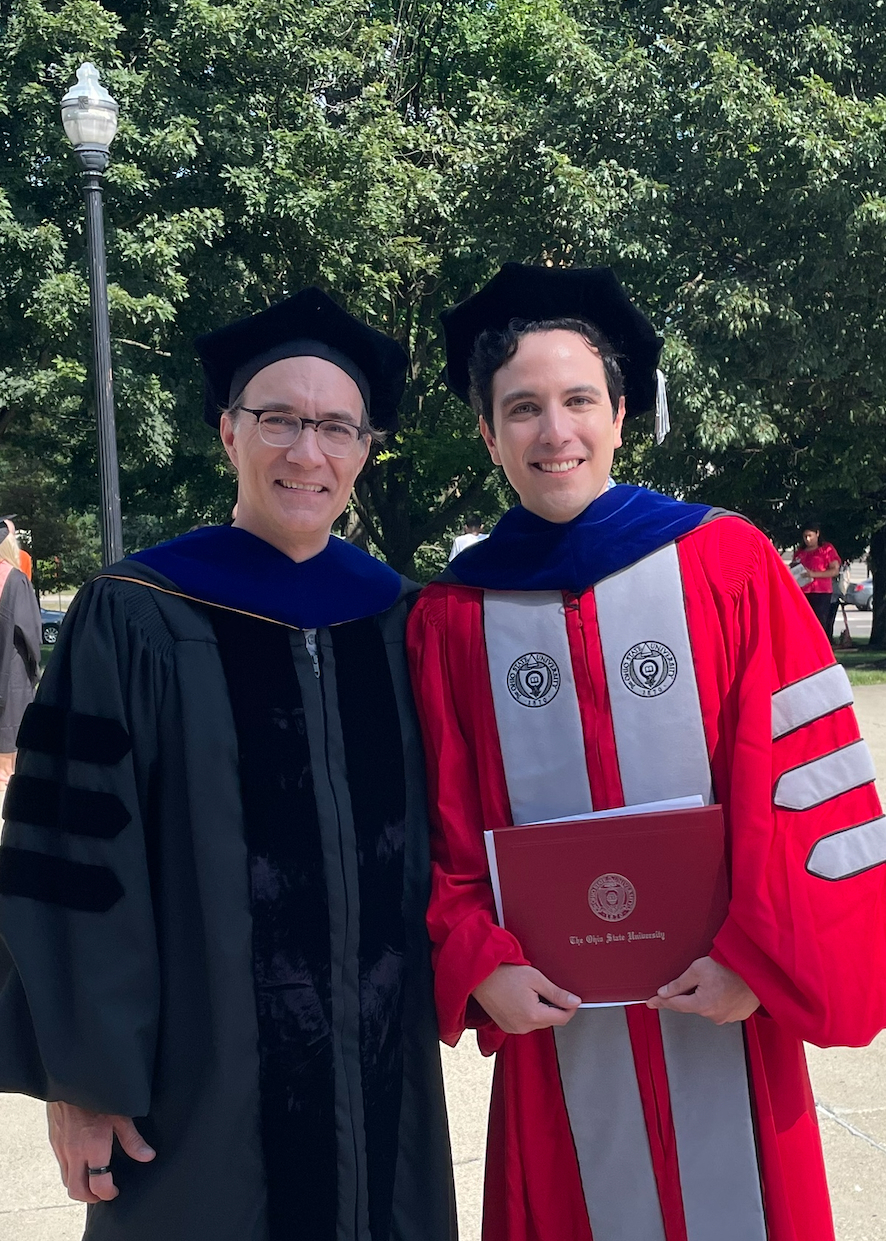
Dr. Cruz Ibarra’s dissertation, Anger and Persuasion in Populist Political Communication: A Dual-Pathway Model, tackles a timely debate with a long history in communication research: does anger enhance or hinder the persuasiveness of populist messages? Through two experimental studies, he proposes a dual-pathway model that explains how anger can simultaneously motivate deeper engagement with messages while also triggering coping responses that reduce elaboration. His findings reveal that anger consistently boosts approach motivation, but its impact on persuasion varies depending on audience characteristics—especially political predispositions. This work offers a nuanced understanding of emotion-driven persuasion and opens new avenues for research in political communication.
Congratulations, Jorge!
More evidence self-reported beliefs are sincere
Rob Bond, Erik Nisbet, and I have a new paper in Political Communication. We looked at how people report their exposure to and belief in political misinformation during the 2020 U.S. presidential election. To do this, we created fake but plausible political claims—some targeting Democrats, others Republicans—and tracked how participants responded over eight survey waves. What stood out was that most people didn’t show strong partisan bias, and expressive responding (saying you believe something just to support your side) was pretty rare. Interestingly, though, bias did increase slightly around the election, suggesting that politically salient event can influence how people talk about their beliefs. We can’t say whether those change reflect sincere beliefs or an uptick in expressive responding, though.
You can read the open access paper here.
Worcester Prize 2025
I am honored to be a coauthor on a paper, led by Dr. Jennifer Brundidge, that received the Robert M. Worcester Prize from the World Association for Public Opinion Research (WAPOR). The Worcester Prize is presented by WAPOR on the annual basis for the year’s outstanding paper contributed to the International Journal of Public Opinion Research.
Brundidge, J., & Garrett, R. K. (2024). The “Clinching Effect” and Affective Polarization: Exposure to Incivility via Social Media in the Presence of Online News. International Journal of Public Opinion Research, 36(3), edae042. https://doi.org/10.1093/ijpor/edae042
Min Seon Jeong
Dr. Min Seon Jeong, who earned her PhD in 2021, has recently accepted a position as an Assistant Professor in communication at Pepperdine University’s Seaver College, where she previously served as a Visiting Assistant Professor. In her new appointment, she will teach a variety of communication courses while continuing her research exploring the ways in which online media can shape individuals’ consumption and processing of political information. Congratulations, Min!
Shannon Poulsen
Dr. Shannon Poulsen, who defended her dissertation in 2023, is now a Sr. Associate of Market Research, JP Morgan Chase. She also serves as the Director of Curriculum for Hashtag Comedy. I can’t imagine a combination more suited to Shannon’s exceptional mix of intellect and humor.
Qin Li
Dr. Qin Li defended her dissertation over the summer. It in, she proposed a new theoretical approach to understand how social network connections shape perceptions of false political claims. She argues that trust in a communication partner and network closure among communicators play pivotal roles in shaping beliefs and sharing intentions. She used an experimental paradigm derived from economic trust games to the theory. This is exciting work and I look forward to see where she takes it next.
Today, Qin is a Preparing Future Faculty for Inclusive Excellence (PFFIE) Postdoctoral Fellow in the Department of Communication at the University of Missouri.
Student updates
This is a long-overdue update on my former students’ many successes. I can’t take credit for all the great things that these scholars and professionals are doing, but take pride in having helped them along their unique journeys.
I’m posting each item separately to make them easier to find, and I’ll start with the oldest news.